

The question I kept coming back to
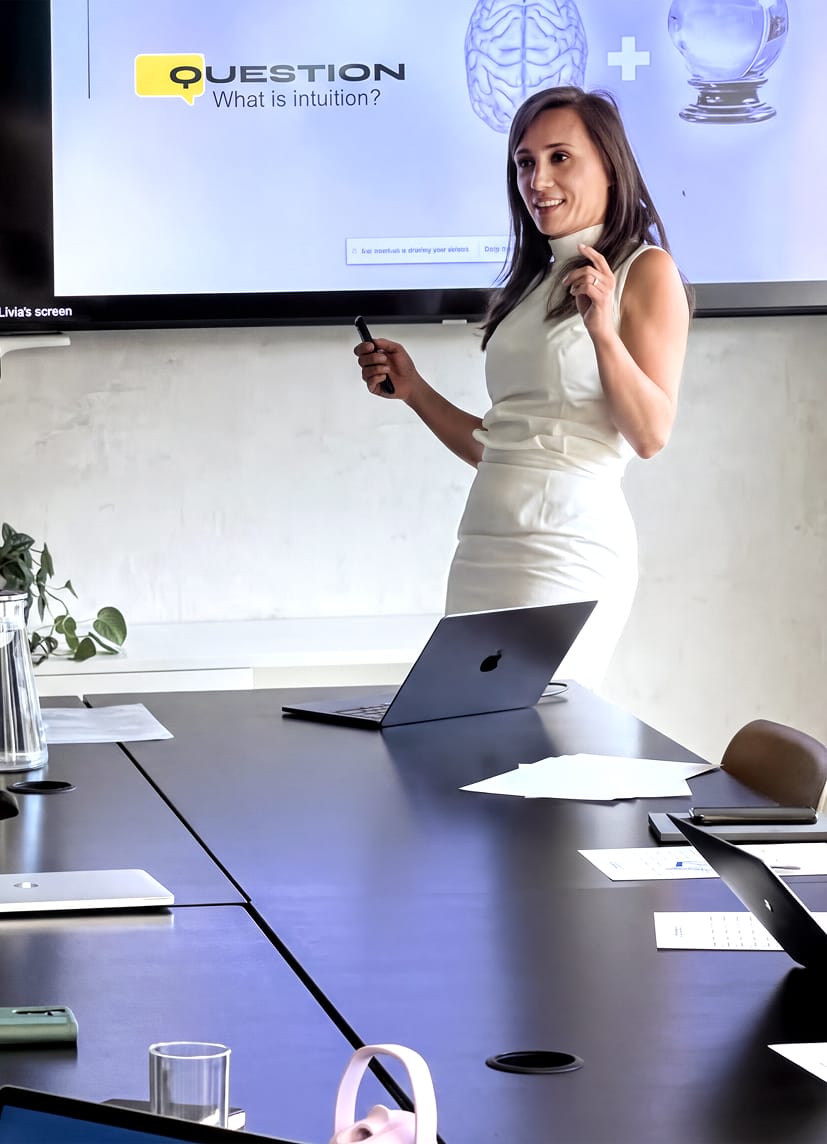
I’m Livia Bernardini. I spent two decades as a CEO and operator working at the intersection of technology, brand, and human behaviour. I worked with leadership teams across Yamaha, McKinsey, BT Group, L’Oréal, Deloitte, Unilever, Ferrari, Barclays, Dyson, and others navigating brand challenges, transformation, AI integration, and high-stakes decisions.
The
predicament
Someone would sense that something was wrong, a partnership, a strategy, a direction, long before the evidence confirmed it. And they would say nothing. Not because they lacked confidence. Because they lacked language. Because “I have a feeling” doesn’t survive a boardroom.
I did it myself. More times than I would like to admit. I kept my intuition quiet, second-guessed it, dressed it up in data afterwards, or let it go entirely. In rooms where I was already working hard to be taken seriously, naming something I could not yet prove felt like a risk I could not afford.
The reactions to my intuitive signals over the years were as varied as the rooms I sat in. Dismissal, reverence, scepticism. More often than not, it was simply easier to stay quiet and perfect the fine art of data led post-rationalisation.
We can
change it
That silence is expensive. It shows up in delayed decisions, stalled projects, or a persistent sense that something is off even when everything looks right on paper.
What changed was science, and the technology that made it visible. MRI scanning, wearable technology, and real time biometric research have allowed us to observe what was previously only felt. The conversation between body and brain. The way subconscious pattern recognition surfaces as a signal before conscious thought arrives. The mechanisms, including opportunistic assimilation, that turn a quiet sense into genuine insight. For the first time, intuition is not just defensible. It is provable. And a capability that can be developed, by anyone, at any level.
Livia Bernardini’s
mission
I am determined to bring this knowledge to the professional environments, where I believe it is most needed.
That is what I am building now. To give intuition the infrastructure, the language, and the legitimate place it has always deserved, so that individuals and teams can use it well, alongside good data and AI, for better decisions and better outcomes.
— Livia Bernardini
Read more on Intuition Edge.
Many tools. One methodology.
All designed around the same principle: that better decisions do not come from more time. They come from better space.
Work with me
